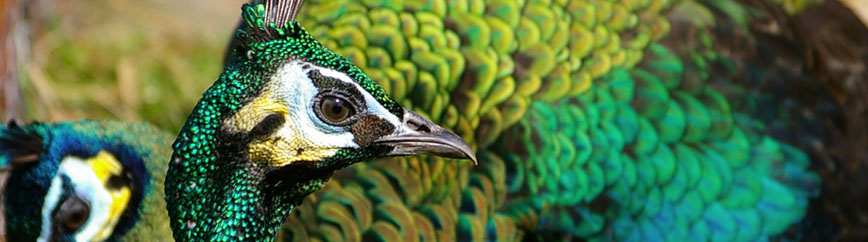
Green Peafowl
Pavo muticus
This large peafowl is much rarer in captivity than its Indian cousin. Captive husbandry has several key differences due to the skittish and sometimes aggressive behaviour of the birds. Hybridisation has been a problem in captivity, hybrids between Indian and Green peafowl are fertile and sometimes are produced intentionally.
Housing
This species requires a large aviary. One male can be housed with many females without incident although introductions can prove difficult and are best attempted on neutral territory or as part of a complete change to the make up of an established group. Perching is essential and a good amount of established cover is beneficial to give nervous specimens a refuge. A soft top to the enclosure is useful as birds will powerfully fly straight up when alarmed and can potentially damage themselves.
The birds are not winter hardy and will require equivalent sized indoor accommodation. These birds are prone to frostbite, in the relatively mild climate of the UK collections rarely require more than a tube heater to prevent damage. Birds can be housed one male to multiple females although keeping them in pairs is also possible.
Breeding Behaviour
Breeding commences in early spring when the male starts to display to the females. Male birds can become extremely aggressive during this time. Eggs are laid on the floor in a scrape located in a corner of the aviary. If parent rearing is desired it can be useful to cover this area top provide a degree of seclusion. Some females choose to lay in elevated boxes. Birds without suitable nesting cover will lay indiscriminately across the floor. Incubation is 27 days. Parent rearing generally proceeds without incident without separating the male. Young birds must be separated prior to the next breeding season or risk being attacked by the adult birds.
Hybrid Peafowl
Asiatic peafowl are closely related and when bred together produce hybrid offspring. The bird in the photograph is an intentional hybrid referred to as a spaulding. This bird also carries a pattern mutation (black shoulder) and is the result of an intentional breeding programme. Notice how, even though it is female, its plumage closely resembles an immature male - this is not uncommon and a useful way of identifying such line bred hybrids.
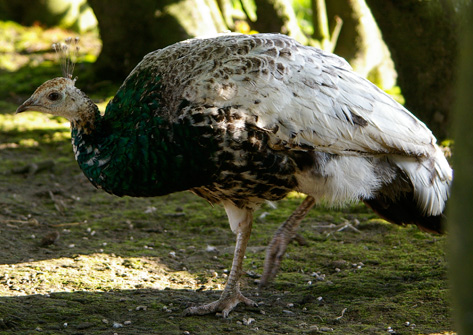
Green peafowl have a rapidly declining population and are endangered. Conservation work requires individuals that are pure bred for reintroduction to the wild. Hybrids are primarily damaging because they are fertile and in some cases difficult to identify, allowing alien genes to spread through the captive green peafowl population.
Hybrid birds mix characteristics found in both peafowl species. The amount of mixing, and how identifiable it is depends upon how often Indian peafowl occur in the birds lineage. The most difficult birds to identify are those where many generations back crossing to pure Green Peafowl has rendered the traits needed to identify hybrids slight or lost altogether. Specimens where hybridisation has been recent are easy to identify.
Offspring from direct Indian to Green peafowl crosses are a distinctive mix between the two species. Indistinguishable hybrids are never produced from such crossings.
Key Hybrid Features
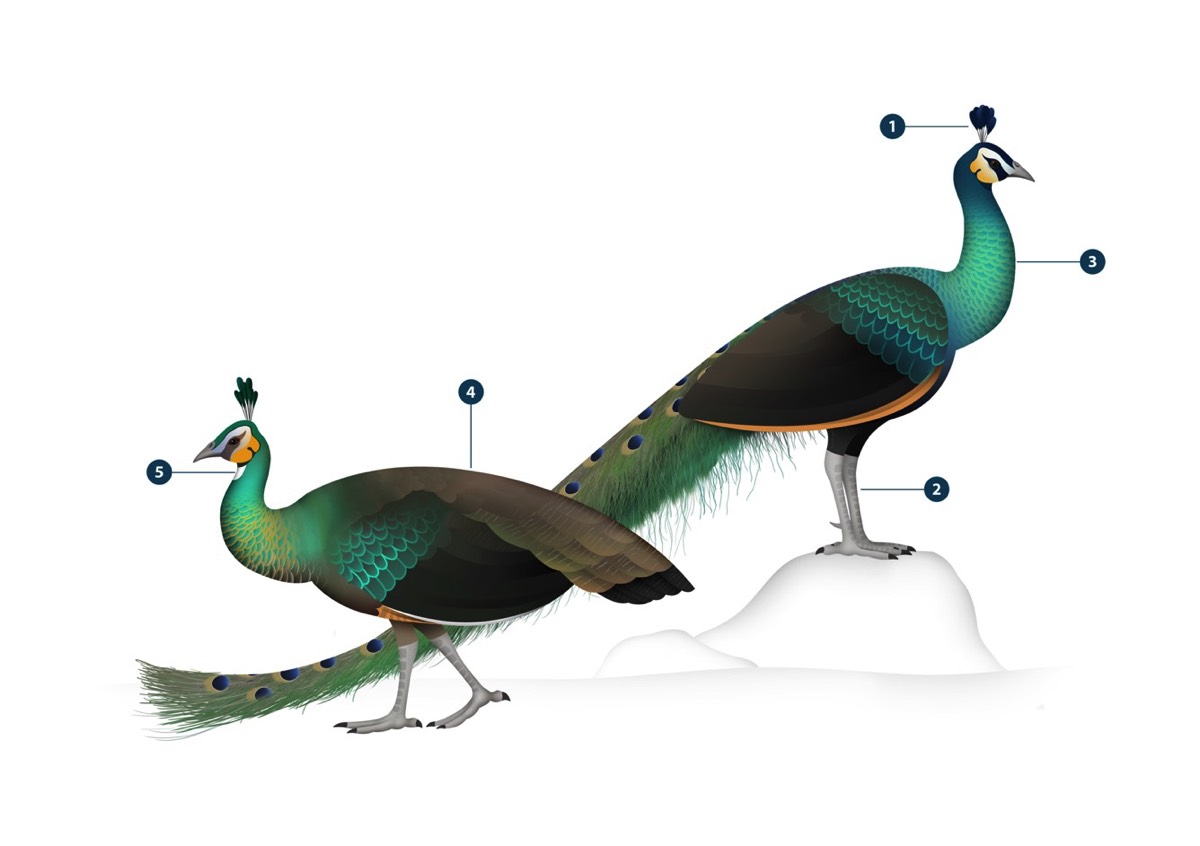
- In pure Green Peafowl crests are always tall, full and tightly bunched. Individual feathers terminate with a point in males and rounded ends in females. In hybrid birds crests are shorter and more fan shaped. The structure of the feathering also differs, typically with bare shafts near the base and rounded ends to the feathers in both sexes.
- Wild green peafowl are tall, slim and long legged. Hybrid peafowl have a lower rounded body shape, and much shorter leg length in comparison.
- In wild birds the neck feathers are always a shade of green dependent upon subspecies. In hybrid males the neck feathers have a turquoise colour. Additionally the scale like effect of the neck feathers is washed out and less distinct in hybrids.
- In hybrid peahens feathering on the back, neck and chest areas is a flat, brown colour with absent or reduced iridescence at the edges.
- Random white feathering occurs in pure captive birds and is itself not a sign of hybrid origins. However birds with the white, or pied Indian Peafowl genes in their ancestry may show distinctive visual signs such as a white throat patch and/or white flight feathers. Birds displaying these features should be treated as hybrids.
Sexual Dimorphism
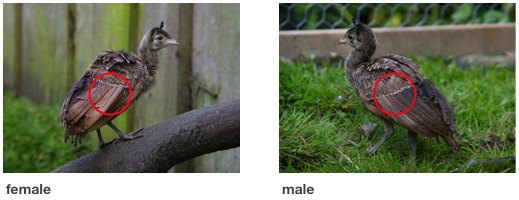
Young Green Peafowl can be difficult to tell if they are male or female without a good comparison. These photographs visually illustrate the difference between males and females at all stages of life.
Wing
Look for the amount of orange on the wing, females tend to have a more solid orange wing feathers where as males have wing feathers with more dark markings.
Crest
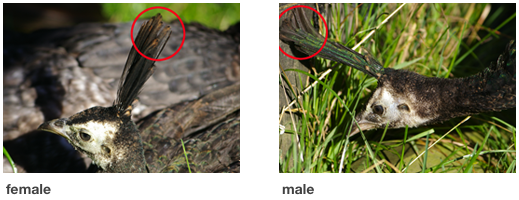
As the birds grow to around two months old features like the crest become more developed females tend to have more brown markings towards at the top of the crest, in males this area is less brown and more iridescent green.
Tail
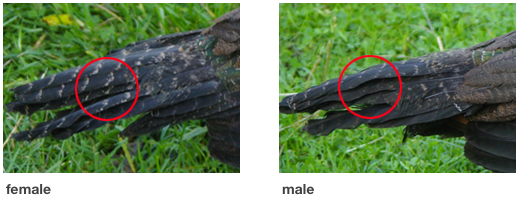
In very young peafowl the feathers in the tail are initially barred. As they grow females retain the strong, crisp barring while the same feature fades in males with the tail feathers becoming progressively darker.
Eye
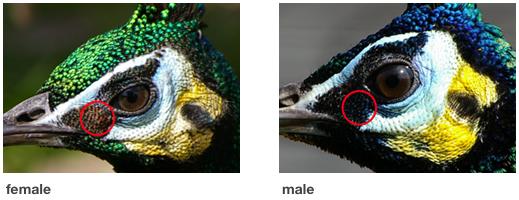
In females the eye strip is mainly brown. In males the same area is mainly iridescent blue. Young males have developed this feature by their second year.
Upper Wing
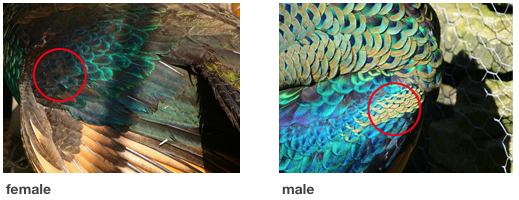
From the second year the upper wing area of the male features the development of feathers similar to those found in the neck in a wedge shaped stripe. In females this feature is absent.
Flight Feathers
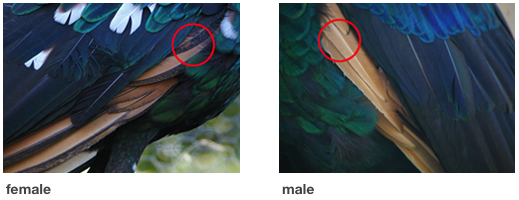
In the male the flight feathers are solid orange often with a small faded dark mark on the tip. In the female the same feathers are strongly patterned with dark markings, especially at the base and on the 'leading edge' of the feather.
Tail Feathers
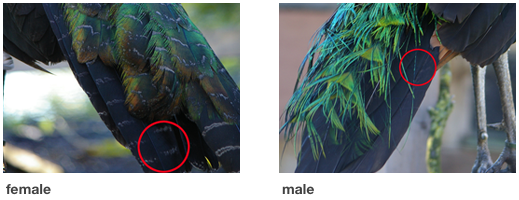
In the female tail feathers are black with a strong pale barring across them, a feature that is retained in females of all ages. The male tail is predominantly black with a small amount of washed out patterning, especially near the shaft and base of the feather.
Spurs
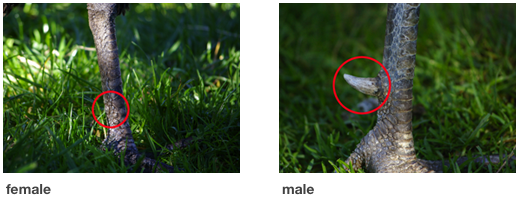
Both male and female green peafowl can develop spurs however their growth is considerably more rapid in the male with them appearing in the second year. The photo compares two three year old birds.